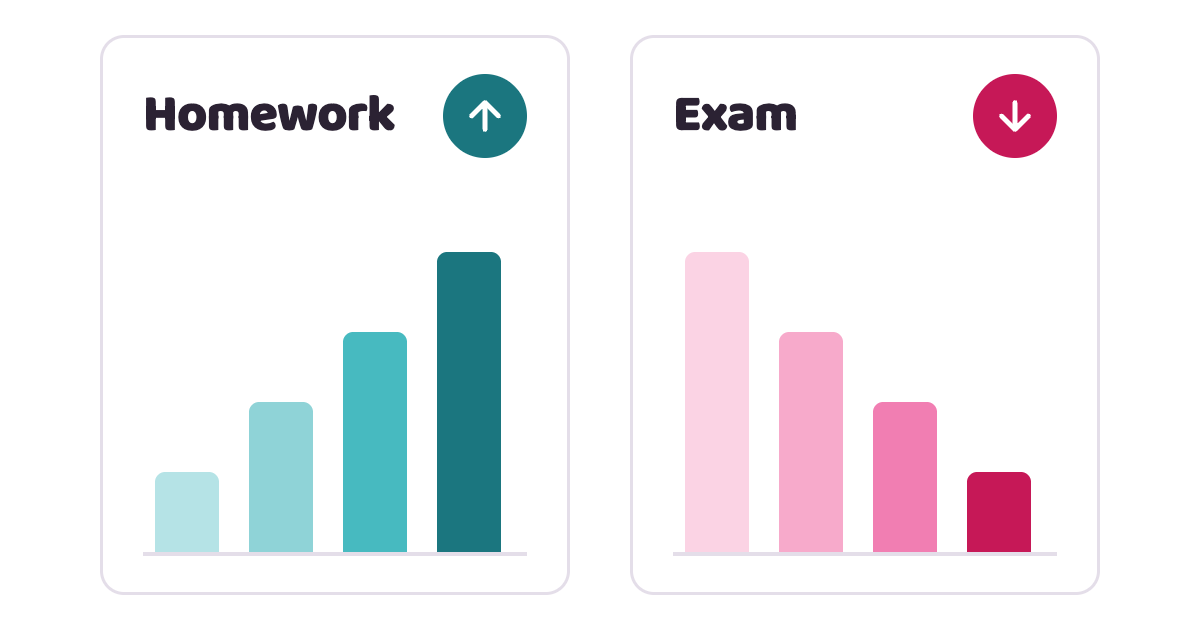
There is a result in AI and education research that keeps turning up, in different countries, with different age groups, using different tools. Students with a general AI chatbot do better on the work in front of them. Then the chatbot goes away, and they do worse than students who never had it. It is worth understanding why, because it changes what a good AI learning tool is supposed to do.
The experiment
Researchers ran a randomised field experiment with nearly 1,000 high school maths students. One group got a standard GPT-4 chat interface to help with practice problems. Another got a guardrailed version that had the teacher's solutions and was told to give hints rather than answers. A third group got nothing. During practice, the standard chatbot raised performance by 48 percent. The guardrailed tutor raised it by 127 percent. Then the AI was taken away and everyone sat an unaided test. The students who had used the standard chatbot scored 17 percent lower than the students who never had AI at all. The guardrailed group did about the same as the control group. Not worse. But not better either.
A general chatbot raised practice scores by 48 percent and lowered unaided test scores by 17 percent.
It is not a one-off
An analysis in The Economist looked at research tracking 27,000 students aged 12 to 18 in China. Students using AI for schoolwork saw homework scores rise by 18 percent and spent less time on it. They also did 20 percent worse on exams than students who did not use AI. A trial in seven English schools, run by Cambridge University Press and Assessment with Microsoft Research, had 344 students aged 14 and 15 study history texts either with an AI chatbot or by taking notes. Three days later, tested without any tools, the note takers won on every measure: what they remembered, what they understood, and what they could recall freely.
The students could not feel it happening
This is the part that should worry parents most. In the English trial, the students rated the chatbot as easier and more helpful than taking notes, and preferred it. They were not using it lazily either: nine in ten asked for deeper explanations, exactly what you would hope for. One in six still pasted the chatbot's words into their notes almost verbatim. And out of 4,929 questions the students asked, exactly six questioned whether the chatbot was right. The tool that felt most helpful taught the least. Researchers call this cognitive debt: the system improves what a student produces today without building what they need tomorrow.
Why this happens
When a student has to answer a question about a text or work through a problem, they have to select, connect and put things into their own words. That effort is the learning. It is uncomfortable and slow, and it is supposed to be. A general chatbot is designed to remove exactly that effort. It is built to be helpful, which usually means resolving the problem as fast as possible. For an adult trying to get a task done, that is great. For a child trying to learn, the machine gets the practice and the child gets the answer.
What to look for instead
The guardrailed tutor in the maths experiment points to the fix, but also to its limits. Stopping the AI from handing out answers prevented the harm. It did not automatically create a gain. Not doing damage is the minimum, not the goal. So when you look at any AI learning tool for your child, ask three things. Who does the thinking, the child or the machine? Does it ask the child questions, or mostly answer them? And would your child do better on a test without it, after using it for a month? If a tool cannot give you a straight answer to that last one, it is worth being careful.
Take these with you
- 1A general chatbot raised practice scores by 48 percent and lowered unaided test scores by 17 percent.
- 2Across 27,000 students, AI users did 18 percent better on homework and 20 percent worse on exams.
- 3Students rated the chatbot as more helpful while learning less from it.
- 4Stopping AI from giving answers prevents harm. It does not create learning on its own.
- 5Ask of any tool: who does the thinking, the child or the machine?